DLive shut down on April 7, 2026. The cause of death is on the federal docket, and it had nothing to do with content moderation.
By Immortal Al
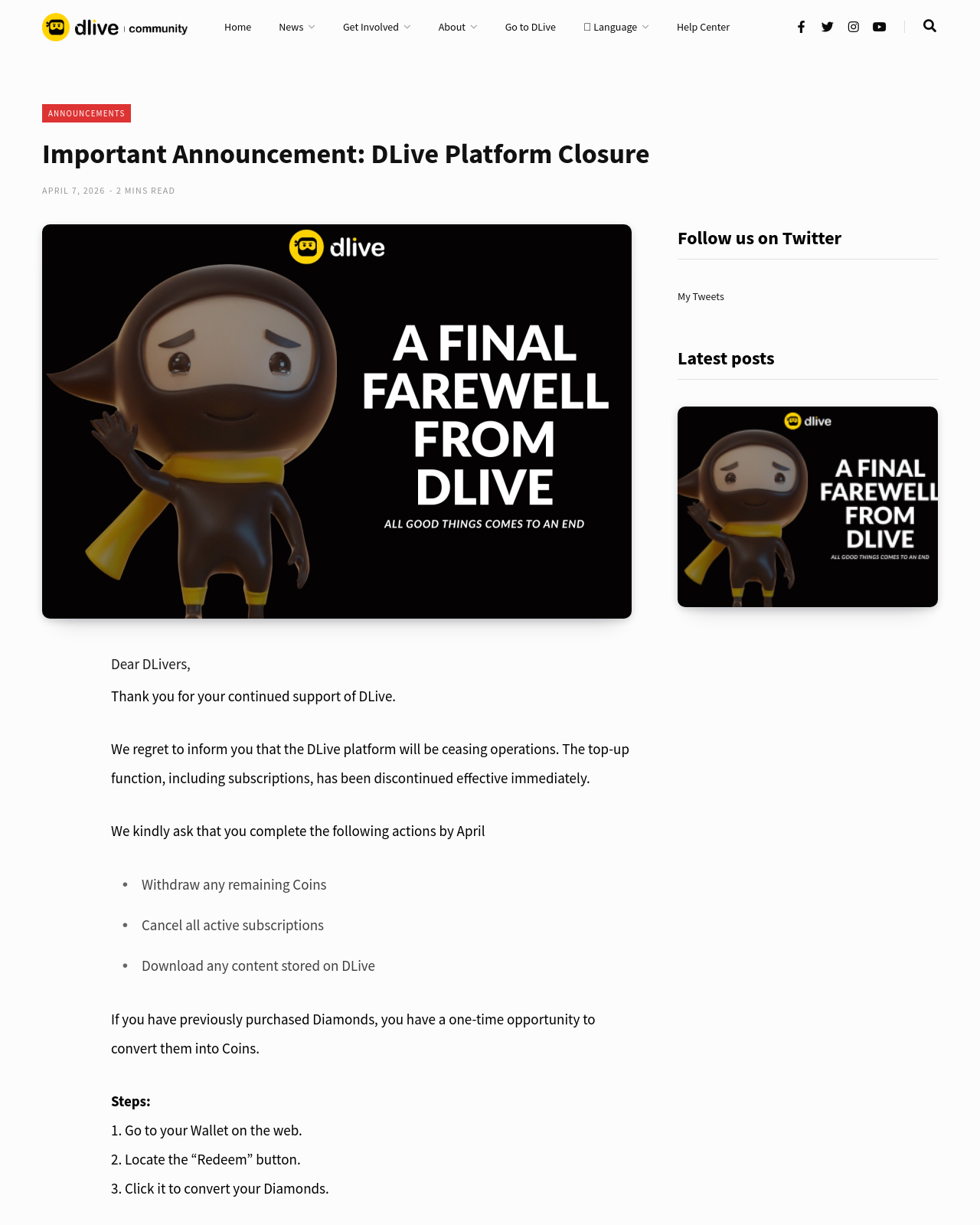
On April 7, 2026, DLive published one paragraph on its community blog and shut down a platform that had been running for eight years.
The post was titled “Important Announcement: DLive Platform Closure.” The URL slug read /important-announcement-dlive-platform-closure/ — out of step with DLive’s normal convention of date-prefixed slugs. The previous post, a St. Patrick’s Day event from March 11, 2026, followed the standard pattern. This one didn’t. Someone typed it in a hurry.
The substance of the announcement: “We regret to inform you that the DLive platform will be ceasing operations. The top-up function, including subscriptions, has been discontinued effective immediately.”
Fourteen words of regret and a billing update, for a platform that had hosted thousands of streamers and processed millions of dollars in creator payments. The announcement gave no reason and named no successor.
This article is about who killed it.
DLive’s closure announcement, posted April 7, 2026 to community.dlive.tv
The short answer is the U.S. federal government, working through the Securities and Exchange Commission, executing a playbook the agency had already proven on a smaller decentralized-streaming platform two years earlier. The SEC did not need to touch a single piece of DLive content. It used securities law to make operating DLive economically impossible for the corporate parent that owned it. The corporate parent paid a fine, accepted an open-ended federal injunction, and shut the platform down rather than absorb the compliance overhead the injunction created.
Justin Sun, who controlled the corporate parent, made some choices that made his own position survivable. Those choices belong in the story. The cause of the story is upstream of him: a regulatory chokepoint built across two administrations to crush platforms the federal government cannot legally touch on speech grounds.
This is what the chokepoint looks like end to end.
The Record
Between January 2021 and April 2026, a coordinated, multi-front campaign moved against DLive’s parent company. The campaign combined NGO reports, congressional letters, regulatory enforcement, and federal litigation. Every claim in this article traces to a verifiable primary source: signed congressional letters with case numbers, SEC court filings, published NGO reports with author bylines, and verbatim quotes on the record.
The campaign ran in five phases. Each phase escalated the legal and financial exposure for DLive’s parent company. The fifth phase produced a court settlement filed March 5, 2026. DLive ceased top-ups the same week. It announced full closure thirty-three days later.
The five phases:
The Cascade (January 2021). Payment processor pressure forces DLive to ban its top-earning streamers within 72 hours of an SPLC report. Two Democratic members of the House Intelligence Committee send a letter to DLive’s CEO by name, on official congressional stationery, six weeks later.
The Containment (2021-2022). Three NGOs, all funded by progressive donors, publish reports and congressional testimony naming DLive and routing dollar figures into the official record.
The Hammer (March 2023). The SEC, under Biden-appointed Chair Gary Gensler, sues DLive’s corporate parent. The mechanism is securities law, not speech law. The target is the BTT token that powered every tip and subscription on the platform.
The Defense (2024-2025). With an active SEC fraud case threatening to classify the token underneath his entire creator-monetization stack as a security, Sun spends $75 million inside the incoming Trump family’s crypto venture. The SEC pauses the case within six weeks of Trump’s inauguration. The same regulatory machine had crushed LBRY two years earlier. Sun paid the insurance premium.
The Settlement (March 2026). Justin Sun walks free. His corporate subsidiary, Rainberry Inc. (DLive’s direct parent), pays a $10 million penalty and accepts a permanent injunction. The injunction applies to every BTT transaction on the platform. The compliance overhead is unbounded. Thirty-three days later, DLive announces closure.
This is the story of what happened between the SPLC’s January 7, 2021 blog post and DLive’s April 7, 2026 funeral notice. The connection runs through named actors, specific documents, and a legal mechanism that, on its face, has nothing to do with what users actually did on the platform. The mechanism ended the platform completely.
Phase 1: The Cascade
January 6, 2021. As rioters moved through the Capitol, at least five DLive accounts streamed live from inside the building. Anthime “Baked Alaska” Gionet was among them. The Southern Poverty Law Center later reported he earned roughly $2,000 from that single livestream.
DLive moved fast. By the end of January 6, Baked Alaska and the account “Murder the Media” were banned. Account balances were frozen. Pending donations were refunded. On January 9, DLive permanently banned Nick Fuentes, the platform’s highest-earning political streamer.
Fuentes was a serious revenue driver. SPLC’s January 7, 2021 Hatewatch reporting documented that DLive donors gave Fuentes $43,822.86 in just the last two months of 2020. SPLC senior fellow Megan Squire, in a 2023 submission to the House January 6 Committee, documented Fuentes’s full DLive donation total at $114,014.12 across the nine months from April 2020 through January 2021.
Then came the January 7 headline.
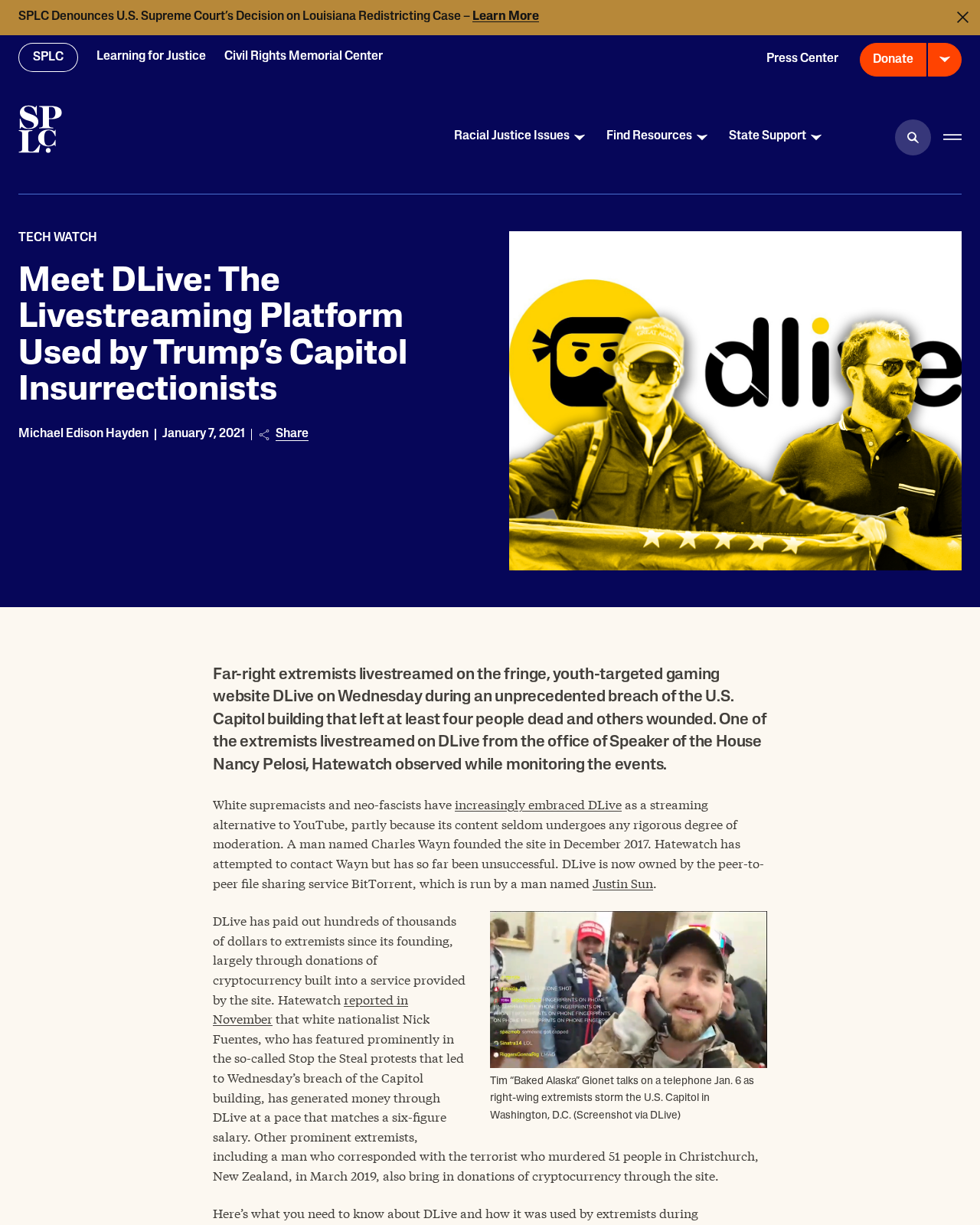
SPLC Hatewatch published “Meet DLive: The Livestreaming Platform Used by Trump’s Capitol Insurrectionists.” Byline: Rachel Janik. The article documented donation totals, named accounts, and tied DLive to the Capitol breach inside 24 hours of the event.
Rachel Janik’s January 7, 2021 SPLC Hatewatch report — the first major-press piece naming DLive
The pressure that arrived next was financial. According to multiple reports, DLive’s payment processor Tipalti threatened to cut ties with the platform. DLive ran the January 9 Fuentes ban after that threat. In March 2021, DLive announced it would discontinue bank transfers effective March 19, leaving Tipalti as its only fiat cash-out gateway. Whatever leverage the processor had at the start of the year, it had more by spring.
Then Congress arrived.
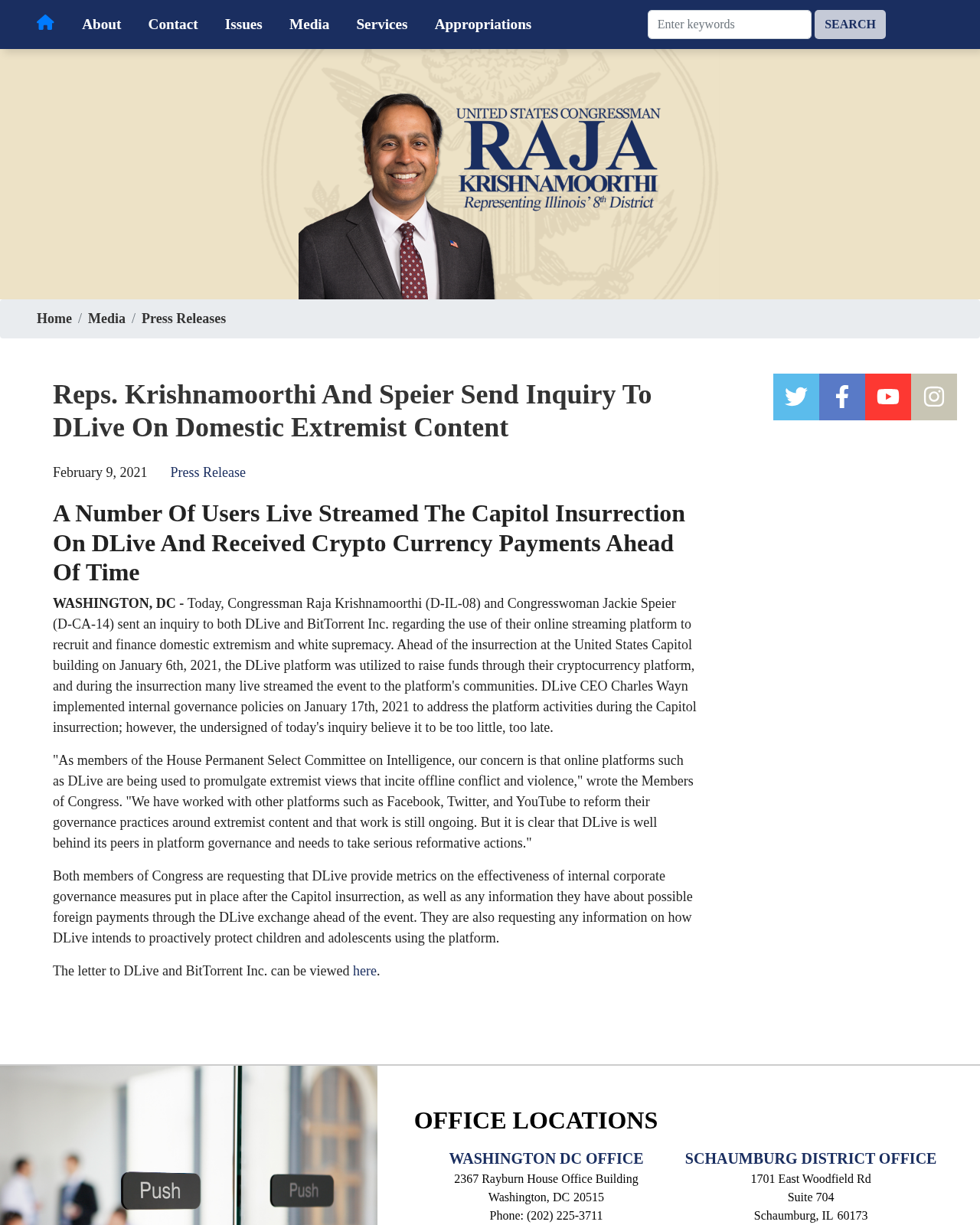
On February 9, 2021, Reps. Raja Krishnamoorthi (D-IL-08) and Jackie Speier (D-CA-14) sent a letter on House Permanent Select Committee on Intelligence stationery. It was addressed to Justin Sun, CEO of BitTorrent, and Charles Wayn, CEO of DLive, by name. The letter stated:
online platforms such as DLive are being used to promulgate extremist views that incite offline conflict and violence
It cited a January 5, 2021 livestream in which a DLive user received approximately $2,800 in donations while encouraging viewers to murder elected officials. It demanded answers on three points: the effectiveness of DLive’s post-January 6 governance changes, whether foreign cryptocurrency payments had moved through the platform before the Capitol attack, and the platform’s protections for minors.
Two members of the House Intelligence Committee. Justin Sun and Charles Wayn named on official congressional letterhead. Six weeks after January 6.
House Permanent Select Committee on Intelligence press release announcing the Krishnamoorthi-Speier letter, February 9, 2021
The campaign had a partner inside Congress now.
Sixteen days later, that partner spoke on the record. On February 25, 2021, Lecia Brooks, Chief of Staff at the Southern Poverty Law Center, testified before the U.S. House Subcommittee on National Security, International Development and Monetary Policy. The hearing topic: domestic terrorism financing. Brooks told the committee that dozens of extremist groups were earning thousands per month on DLive, and that Baked Alaska had made roughly $2,000 from his January 6 livestream alone.
SPLC published the Hatewatch story in January. In February, the same organization read those dollar figures into the congressional record. The recipient was the Congress that had just written DLive’s CEO by name.
By the end of February 2021, DLive’s situation had three components locked in: a payment processor with a documented threat history, a House committee with named correspondents, and an NGO running ammunition into both. The platform had banned its top earners, frozen their funds, and absorbed the revenue hit.
It still had eight years to live. The mechanism that would actually close it was two years out.
Phase 2: The Containment
The pressure that arrived in February stayed. It just changed letterhead.
Six months after the Krishnamoorthi-Speier letter, the Institute for Strategic Dialogue, a London-based think tank, published a report titled Gaming and Extremism: The Extreme Right on DLive. The author, Elise Thomas, wrote it as part of ISD’s “Future of Extremism” programme. Verbatim from the report:
DLive had a reputation amongst the extreme right community as a good place to stream because of its weak content moderation and in-built ability to monetise content
Two phrases mattered. “Weak content moderation” became the moderation-policy frame for every subsequent NGO write-up. “In-built ability to monetise content” was a reference to BTT, the BitTorrent Token that powered every tip and subscription on the platform. The report had quietly named the actual revenue mechanism that would, two years later, become the SEC’s legal handle.
Then came the dollar figures.
On March 31, 2022, the Anti-Defamation League submitted written testimony to the House January 6 Select Committee. The title: Nicholas Fuentes, the Groypers, and January 6, 2021. The document put on the record that Nick Fuentes earned “more than $114,000 from DLive viewer donations between April 2020 and January 2021.” It listed specific dates: $2,323.23 received on January 4, 2021. $2,831.64 received on January 7. Two days bracketing the Capitol breach. Down-to-the-cent precision in the official congressional record.
The ADL testimony accomplished three things at once: positioned DLive inside the highest-profile congressional investigation in modern history, documented the platform’s most controversial earner with exact figures, and routed the package through Government Publishing Office channels, where it received a permanent identifier and a federal repository URL.
By the end of 2022, three categories of institutional pressure were operating in parallel. Payment processors had a documented willingness to pull the plug on DLive accounts. Two members of the House Intelligence Committee had a corporate correspondent on file. A network of think tanks and NGOs (ISD, ADL, SPLC) was producing a steady stream of reports and testimony, with the documents citing one another and entering official records that future regulators could reference without having to gather their own evidence.
DLive’s content moderation problem was, by this point, mostly resolved. The top streamers were gone. The wartime monetization spike of late 2020 was a memory. What remained was a paper trail.
The paper trail was the asset that mattered next.
Phase 3: The Hammer
For two years, the pressure on DLive came through processors, journalists, and Congress. None of it touched the platform’s underlying revenue infrastructure. The bans cost DLive its loudest streamers but left the BTT token, the on-chain rails, and the corporate parent untouched.
On March 22, 2023, that changed.
The U.S. Securities and Exchange Commission, under Chair Gary Gensler, filed SEC v. Sun, et al. in the Southern District of New York. Case number 1:23-cv-02433-ER. Judge Edgardo Ramos drew the assignment. The Enforcement Division was led by Gurbir S. Grewal, who would depart the agency in October 2024.
The defendants:
Justin Sun, individually
Tron Foundation Limited
BitTorrent Foundation Ltd.
Rainberry Inc., the company formerly known as BitTorrent Inc., and DLive’s direct corporate parent
Eight celebrity endorsers, including Jake Paul, Lindsay Lohan, Akon, Ne-Yo, Lil Yachty, Soulja Boy, Austin Mahone, and Kendra Lust
The corporate architecture of those defendants matters, because the SEC’s eventual choice of who to enjoin and who to dismiss becomes the entire story by 2026.
Justin Sun built or bought every piece. In 2017, Sun founded the Tron Foundation in Singapore as the issuer of the TRX token. The U.S. file-sharing company that the public knew as BitTorrent had already, in early 2017, quietly renamed its legal entity to Rainberry Inc., while keeping BitTorrent as a brand name for its file-sharing products (the same legal-name-vs-brand-name split as Alphabet and Google). In June 2018, Sun’s Tron acquired Rainberry Inc. for a reported $140 million. He then layered the BitTorrent name onto a new crypto product. The BitTorrent Token, BTT, was issued by a separate Sun-controlled entity called BitTorrent Foundation Ltd. This was a different legal entity from Rainberry: both used the BitTorrent name, and both answered to Sun, but they were sister entities under his control, not parent and subsidiary. The distinction would matter enormously when the SEC began choosing whom to charge. In December 2019, Rainberry acquired DLive, a livestreaming platform launched in 2017.
By 2020, when DLive’s revenue from far-right streamers became a press story, the chain ran: Justin Sun → Tron Foundation → Rainberry Inc. → DLive. The token that powered every DLive transaction (BTT) was issued by BitTorrent Foundation Ltd., legally distinct from Rainberry but controlled by the same person.
The SEC’s complaint named all of them. Rainberry was on the list even though it had not issued BTT, because the SEC’s theory of Rainberry’s involvement was operational: Rainberry was the U.S. corporation that distributed BTT through its consumer products. Every tip on DLive moved BTT into the hands of a U.S. user, and every subscription priced in “Lemons” converted user payments into BTT activity on Rainberry’s platform. If BTT was an unregistered security, then Rainberry was the entity through which most of the U.S. retail volume in that security flowed. Naming Rainberry made the case enforceable on American soil, regardless of where the Foundation that technically issued the token was incorporated.
The settlement three years later would treat the four entities very differently.
The complaint focused exclusively on financial conduct: token issuance, wash trades, undisclosed endorsements. DLive’s content moderation, January 6, and the named streamers appeared nowhere in the document. The legal theory was securities law, applied to a token.
The SEC’s specific allegations:
Unregistered offer and sale of TRX (Tronix) and BTT (BitTorrent Token) as crypto asset securities
$31 million in proceeds from “illegal, unregistered offers and sales” of TRX
$70 million from the initial coin offering (the “war chest” in SEC parlance)
More than 600,000 wash trades of TRX between two crypto trading accounts Sun controlled
Daily wash trading volume between 4.5 million and 7.4 million TRX
Period of conduct: April 2018 through February 2019
An undisclosed paid celebrity endorsement scheme
The celebrity defendants settled fast. Lindsay Lohan paid $40,670 at filing. Jake Paul paid $101,887. Akon, Ne-Yo, Lil Yachty, and Kendra Lust split a $400,000 aggregate. Soulja Boy held out at filing. Austin Mahone settled five months later for roughly $46,000. Each settlement closed a small piece of the case and left the central charges against Sun, Tron, BitTorrent, and Rainberry intact.
For DLive, the load-bearing word in the complaint was BTT.
Every tip a viewer sent on DLive used BTT. Every subscription priced in “Lemons,” DLive’s user-facing currency, was a BTT transaction underneath the wrapper. If BTT was a security, then every transaction on DLive was a securities transaction, executed by an unregistered platform, on behalf of a corporate parent now under federal enforcement.
There was a precedent for what came next.
In March 2021, the SEC had filed SEC v. LBRY in the District of New Hampshire. LBRY was a decentralized video-sharing platform built on the LBC token. The template matched: token sold to fund the platform, token used to pay creators, allegation that the token was an unregistered security. In November 2022, Judge Paul Barbadoro granted summary judgment for the SEC. LBC was a security. The SEC initially demanded $22 million. The final penalty in May 2023 was $111,614, reduced because LBRY was already, as the court put it, “near-defunct.”
The LBRY ruling did not impose ongoing compliance costs by itself. The summary judgment did. Once a token was classified as a security, the issuer was on the hook for registration, ongoing disclosure, and exchange-registration requirements that no startup creator-monetization platform could realistically absorb. LBRY filed a notice of appeal in September 2023 and abandoned operations by year-end.
Jeremy Kauffman, LBRY’s CEO, gave the eulogy in plain language: the SEC was “out to damage or destroy” the crypto industry in America.
The DLive analog was now in the record. Rainberry’s lawyers had to read the LBRY decision and run the same calculation. Same legal theory, same compliance burden, with one difference: Sun’s corporate ecosystem had reserves LBRY never had, which made the prize bigger and the case worth pursuing.
The SEC’s complaint was the hammer in March 2023. The blade was the BTT classification, due at summary judgment, possibly years away. The hammer alone was enough to start draining Rainberry’s legal budget.
Phase 4: The Defense
The Rainberry case ground through 2023 and 2024. Sun’s lawyers filed motions. The SEC filed responses. The docket grew. Nothing material moved.
Then the calendar moved.
In September 2024, the Trump family launched World Liberty Financial alongside Steve Witkoff (later named Trump’s Middle East envoy), his sons Zach and Alex Witkoff, Zachary Folkman, and Chase Herro. In October 2024, WLF sold approximately 20 billion WLFI tokens at $0.015 each, raising roughly $300 million. By the time of Trump’s most recent disclosure year, his personal income from WLF was reported at $57 million, with the Trump family’s total take from WLFI sales near $390 million.
Justin Sun was paying attention.
On November 25, 2024, Sun publicly announced a $30 million WLFI purchase, approximately 57% of all WLFI tokens sold in the initial round. The announcement came via his @justinsuntron account on X. The next day, WLF named him an advisor. Reporting put his stake at 10%.
Sun did not stop there. By January 2025, his total WLFI investment had climbed to $75 million. On January 20, 2025, Trump’s inauguration day, he bought into the $TRUMP memecoin as well. By Sen. Elizabeth Warren’s accounting, the cumulative figure across Trump-linked crypto ventures reached $90 million.
The SEC’s case against Sun’s parent company was, at this point, ongoing under a Biden-appointed enforcement director.
That changed on January 20, 2025, the same day Sun bought $TRUMP. Gary Gensler departed. The SEC’s acting chair became Mark Uyeda, a Trump transition appointee. Paul Atkins followed as confirmed Chair shortly after.
On February 26, 2025, the SEC and Sun’s defense team filed a joint motion to stay the case. The stated purpose, verbatim from the filing:
jointly move to stay this case to allow the Parties to explore a potential resolution
The SEC signer was Adam B. Gottlieb. The defense signer was Jennifer Bretan of Fenwick & West LLP. Judge Edgardo Ramos granted the motion the next day, February 27, 2025.
Six weeks. From inauguration to the SEC asking the court to pause its own active fraud case.
The political track ran in parallel. On May 22, 2025, Sun attended a private dinner at one of Trump’s D.C.-area golf courses, an exclusive event for top $TRUMP memecoin holders. The relationship looked, by mid-2025, as durable as a publicly attended dinner can be.
There were tremors. On September 4-5, 2025, World Liberty Financial blacklisted Sun’s $107 million WLFI wallet. The breach was reported by Axios, Fortune, and CoinDesk. Whatever it represented, it did not derail the SEC track.
The SEC’s enforcement leadership had its own turbulence. Margaret Ryan was named Director of the Division of Enforcement on August 21, 2025, and joined the agency on September 2. Her stated mission, per the SEC’s own announcement, was to refocus the division on fraud, market manipulation, and abuses of trust, the kinds of cases that “inflict the greatest harm,” and away from technical rule violations.
She resigned six months later, on March 16, 2026. The SEC’s announcement gave no reason.
Eight days later, Reuters published one. Citing sources inside the SEC, the wire service reported that Ryan had wanted to bring fraud charges against three high-profile figures with ties to President Trump: Justin Sun, Tesla CEO Elon Musk, and Changpeng Zhao, the founder of Binance. Chair Paul Atkins and the SEC’s other Republican political appointees refused to authorize the cases.
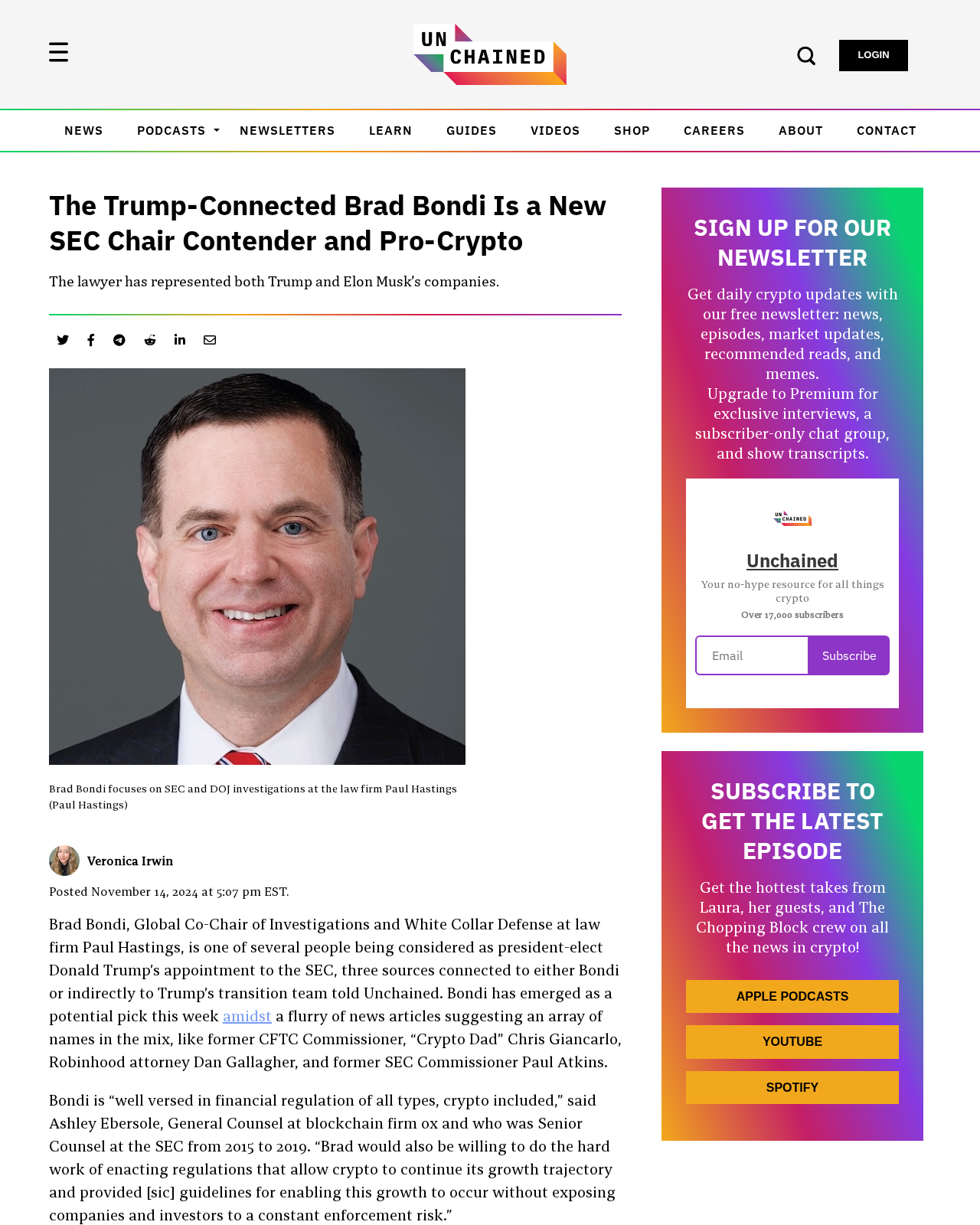
At one internal SEC meeting, Ryan publicly objected to a tactic she said was undermining enforcement: defense attorneys for wealthy SEC targets were bypassing career staff and lobbying political appointees directly. The attorney she named was Brad Bondi, a partner at Paul Hastings who had previously served as counselor to Chair Atkins. Trump had publicly considered Bondi for the SEC Chair seat itself in late 2024 before naming Atkins.
Bondi was on the defense teams for two of the three cases Ryan had wanted to bring. In the Musk matter, he represented Tesla in the SEC’s fraud case over Musk’s misleading vehicle-production tweet. In the Sun matter, per Reuters reporting, Bondi was among the lawyers who negotiated the $10 million Rainberry settlement that closed SEC v. Sun et al. on March 5, 2026, eleven days before Ryan resigned.
Brad Bondi is the brother of Pam Bondi, the U.S. Attorney General.
Unchained Crypto’s November 2024 profile naming Brad Bondi as a Trump-considered SEC Chair contender
Ryan resigned because the cases she wanted to bring were being blocked, while the cases that did close went to attorneys with the right Atkins-era connections. Sun’s was the visible example. Reuters laid both threads out.
The SEC denied politics had shaped enforcement. Verbatim from the agency’s spokesperson:
In every case, the Commission has faithfully applied the federal securities laws. Debate and discussion among our lawyers and other staff is common and encouraged.
Sen. Richard Blumenthal’s March 30, 2026 letter to Atkins, opening a Permanent Subcommittee on Investigations inquiry into the dismissal, named the structural problem directly: “This is a clear example of how President Trump’s blatant crypto corruption creates back doors for his family’s business partners, creating a pay-to-play enforcement regime that turns a blind eye to grave threats to national security and consumer protection.” Sen. Elizabeth Warren’s separate letter to Atkins the same day put the broader pattern in plainer terms: “if you have the ability to pay or have connections to the President, you can act with impunity.”
By the time Ryan resigned, the deal was already done.
On September 17, 2025, Rep. Sean Casten (D-IL) and Sen. Jeff Merkley (D-OR) sent SEC Chair Paul Atkins an eleven-question letter. They asked about SEC-White House communications regarding the stay, direct contact with Sun’s counsel, and whether the SEC would commit to placing Tron on its debarment list. The letter cited FinCEN’s 2023 finding that Tron is “growing in popularity among illicit actors.”
The letter received the response such letters typically receive.
The chronology is undisputed: $75 million into a Trump family crypto venture in late 2024, a $90 million cumulative position across Trump-linked crypto products by January 2025, an SEC enforcement case paused six weeks after the administration changed, a private dinner with the President for top memecoin holders five months later, and an enforcement director who pushed back on the relevant cases and lasted six months.
This chronology has the shape of defensive math. Sun was facing three more years of legal fees, potential disgorgement, civil penalties, and the existential possibility of BTT being classified as an unregistered security across every Sun-controlled platform that used it. The current enforcement environment was Gensler’s SEC pursuing crypto cases on Biden-administration political objectives. Against that exposure, $75 million in WLFI tokens was a calculated bet on a different enforcement environment under a different administration.
The hammer that came down in March 2023 was, by late 2025, suspended above the parent company. The end of the case came next, on different terms.
Phase 5: The Settlement
The new terms arrived on March 5, 2026. The SEC and Sun’s legal team filed a settlement in the Southern District of New York. Judge Edgardo Ramos signed off the same week.
The terms broke into two parts.
For the individuals: every claim against Justin Sun (personally), the Tron Foundation, and the BitTorrent Foundation was dismissed with prejudice. The dismissal carried no fraud finding, no admission, and no retained court jurisdiction. Sun walked away clean.
For the company: Rainberry Inc., DLive’s direct corporate parent, agreed to pay a $10 million civil penalty and accepted a permanent injunction under Section 17(a)(3) of the Securities Act. Rainberry was barred, going forward, from any conduct that creates a false or misleading appearance of market activity.
That was the killer.
The $10 million penalty was something Sun’s ecosystem could absorb, a cost of business, the price of getting the case closed. The injunction was open-ended. Section 17(a)(3) sets no dollar cap on future violations and imposes no end date on the bar.
The asymmetry in the settlement was the point.
The dismissals against Sun, Tron Foundation, and BitTorrent Foundation kept Sun’s broader corporate ecosystem clean. He could keep operating Tron, keep promoting BTT in other contexts, and keep his $75 million WLFI position intact. Nothing in the settlement constrained him personally.
The injunction against Rainberry did the opposite. It bound the corporate subsidiary that operated DLive to a permanent federal order regulating its future conduct. And DLive was the single product line in Rainberry’s portfolio that generated continuous, high-volume BTT activity: hundreds of streamers, thousands of viewers, millions of micro-tips and subscription transactions per month, all settled in the token whose marketing had triggered the original complaint.
That activity now had to be audited going forward against the injunction’s standard: no conduct that creates a false or misleading appearance of market activity. For a payment platform handling millions of small token transactions, that standard demanded open-ended affirmative compliance. Every coordinated tipping pattern, every botted view, every promotional campaign on the platform became a potential violation Rainberry’s lawyers had to evaluate.
Rainberry had three options.
Building compliance infrastructure to operate DLive under the injunction required real-time market surveillance, KYC on every streamer, audit trails on every transaction, and standing legal review on every economic feature DLive shipped. The platform had been revenue-marginal since the 2021 streamer bans and the 2022 NGO pressure campaign. The math did not work.
Selling required a buyer. The DLive brand carried January 6 baggage, the NGO paper trail, and known banking pressure. Any price high enough to cover Rainberry’s exit cost would price out the buyers willing to take the brand at all.
That left shutdown. DLive’s top-up function went dark the same week the settlement was signed. Existing balances stopped earning new contributions. The platform stayed online for thirty-three days, but its economy had stopped. On April 7, 2026, the closure announcement appeared on community.dlive.tv with the URL slug that read like it had been typed in a hurry.
The injunction continued to bind Rainberry. Rainberry no longer operated the asset that made compliance impossible. Brad Bondi was among the lawyers who shaped both halves of the deal.
The reaction came fast.
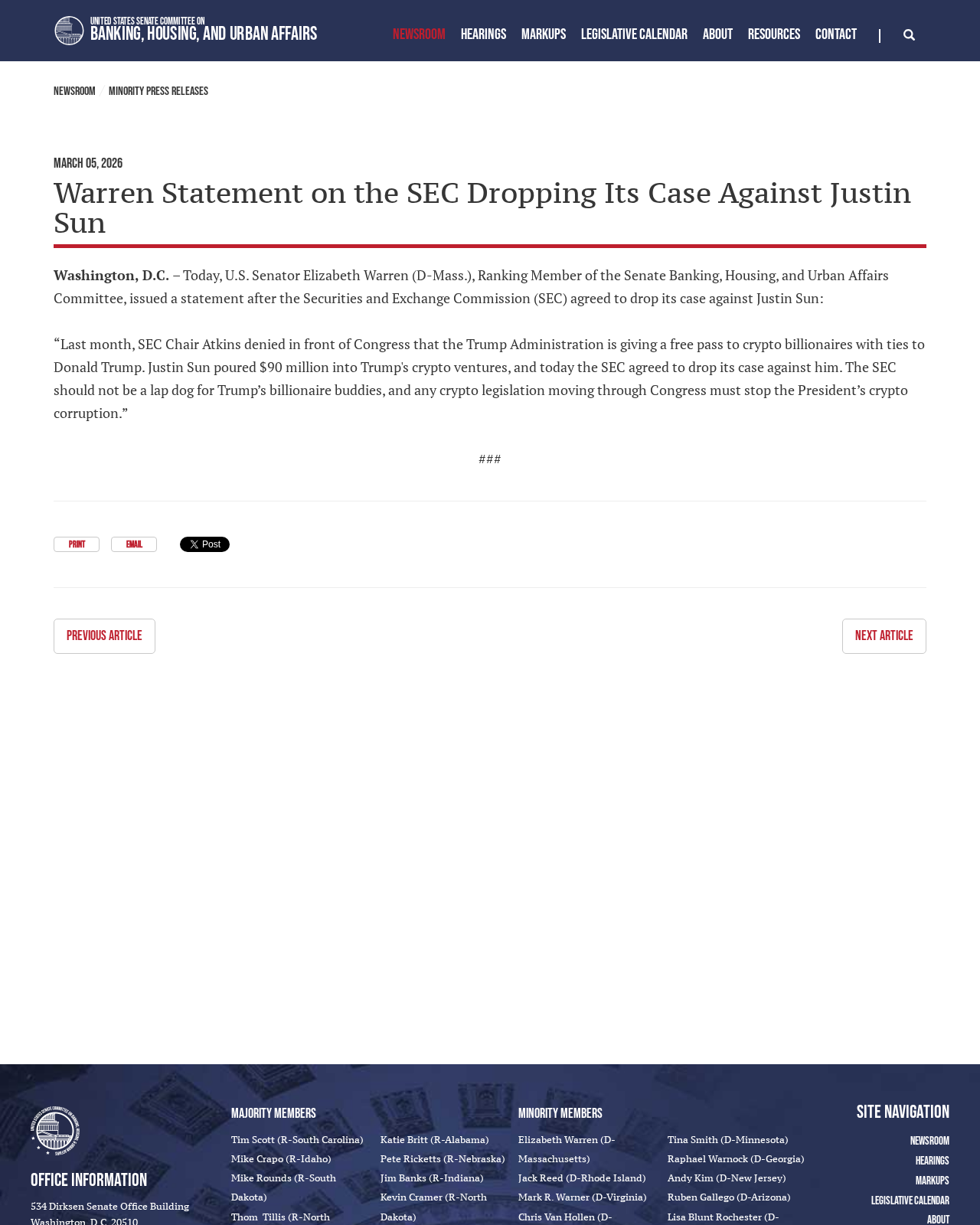
On March 5, the day of the filing, Sen. Elizabeth Warren issued a statement through the Senate Banking Committee minority. Verbatim:
Last month, SEC Chair Atkins denied in front of Congress that the Trump Administration is giving a free pass to crypto billionaires with ties to Donald Trump. Justin Sun poured $90 million into Trump’s crypto ventures, and today the SEC agreed to drop its case against him. The SEC should not be a lap dog for Trump’s billionaire buddies, and any crypto legislation moving through Congress must stop the President’s crypto corruption.
Sen. Elizabeth Warren’s statement, issued through the Senate Banking Committee minority on March 5, 2026
Amanda Fischer, Policy Director at Better Markets, called the dismissal “outrageous” and urged the presiding judge to reject the settlement. From her March 5 statement:
Even though the SEC had overwhelming evidence against Sun and his crypto businesses, the commission today entered into a sweetheart settlement.
The judge did not reject it.
The hammer fell in March 2023. The blade fell on March 5, 2026.
The Verdict
The five phases ran end to end. Every claim above traces to a primary source.
Phases 1 and 2, the content-moderation pressure of 2021 and 2022, cost DLive its top earners and its quietest news cycles. The platform absorbed them.
Phase 3, the SEC complaint of March 2023, opened a different front. The pressure that mattered moved off the platform and onto the parent company’s legal budget. The platform absorbed that too.
Phase 4 was where the math changed. With an active SEC fraud case threatening to classify the token underneath his entire creator-monetization stack as a security, Sun spent $75 million inside a Trump family crypto venture. The same regulatory machine had crushed LBRY two years earlier. The $75 million was an insurance premium. Sun paid it. The SEC paused the case six weeks after the administration changed. The agency’s enforcement director, who had been hired to pursue real fraud, resigned six months later because she could not get authorization for the Trump-circle cases. The defense attorney who closed Sun’s case was the SEC Chair’s former counselor and the brother of the U.S. Attorney General. Every layer of this is corrupt. The corruption belongs to the office. The petitioner is the symptom.
Phase 5 was the kill. Sun walked free. Rainberry paid $10 million and accepted an open-ended Section 17(a)(3) injunction. DLive’s economy stopped the same week. The platform announced closure thirty-three days later.
The chain of causation does not require a smoking gun. The smoking gun was on the docket: a permanent federal injunction binding the corporate subsidiary that operated DLive, conditioning every future BTT transaction on a fraud-prevention compliance regime no creator-tipping platform could affordably meet. Brad Bondi was on the defense team that shaped the terms. Bondi was the immediate hand the public could name. The mechanism that put the gun on the docket was older than Bondi’s appointment.
The mechanism was securities law applied to a token. The Howey Test, born from a 1946 Supreme Court case about Florida orange grove leases, was used in 2023 to classify a digital token whose buyers held it to tip livestreamers. The classification turned every microtransaction on a video platform into a federal compliance event. The token became the vector that delivered the kill order to a platform the SEC could never have touched on speech grounds.
This is the model. The federal government will not say “we are shutting your platform down because we don’t like what you stream.” It will sue your corporate parent for unregistered securities, force a settlement, and walk away with an injunction that makes operating the platform legally impossible. The platform shuts itself down to limit ongoing exposure. The SEC never has to touch the content. The First Amendment is never tested. The platform dies of secondary infection.
DLive is the second documented kill of this model. LBRY was the first. Both ran token-based creator economies that put their parent companies on the wrong side of the Howey Test. The first platform survived eight months after losing summary judgment. The second platform survived thirty-three days after settling. The third application of the model is a question of when, not whether.
Credit for the kill, in three tiers.
The mechanism is older than any of the actors named in this article. The U.S. federal government built the regulatory architecture across the Biden and Trump administrations: the bipartisan acceptance that crypto tokens are securities by default, that creator-monetization platforms are securities exchanges by extension, and that an SEC injunction is a legitimate substitute for a content-moderation order the First Amendment would never permit. The political class produces the rules. The administrative state executes them. Both parties prefer this arrangement.
Building the political environment that authorized the SEC to act fell to SPLC, ADL, ISD, GPAHE, and Reps. Krishnamoorthi and Speier. They manufactured the consensus that DLive specifically deserved enforcement attention. They built the firing range that the SEC ultimately fired from.
At the trigger were the actors who chose specific outcomes within rules they did not design: Justin Sun, who chose the asymmetric settlement that saved his other businesses by sacrificing DLive; Brad Bondi, who was on the defense team that shaped the asymmetry; Paul Atkins, who authorized it; the SEC enforcement leadership that overruled Margaret Ryan when she pushed back. Each made the choices that benefited them within a game designed elsewhere.
The model is portable. The DLive case used securities law against a token-based payment rail, but the chokepoint architecture extends to any financial dependency a platform cannot replace. Odysee sits closest to DLive’s vulnerability profile because it runs on the same LBRY blockchain whose LBC token the SEC already classified as a security. Bitchute lost PayPal, Stripe, and Patreon in 2018 and survives on a rotating set of payment processors any one regulatory letter could close. Rumble runs on conventional payment rails but depends on Apple and Google app stores that have removed alt-tech platforms before (Parler and Wimkin in January 2021). Substack runs entirely on Stripe; the day Stripe declines to renew Substack’s processing relationship, every paid creator on the platform loses recurring income. Different rails, same model: find the financial dependency the platform cannot replace, then apply political or regulatory pressure until it breaks.
DLive’s users sat outside every room where these arrangements were made. They subscribed, tipped, streamed, and built audiences on a platform whose continued existence depended on a corporate parent’s ability to navigate a regulatory environment they had no voice in shaping. When the parent could no longer navigate, the platform vanished. Their followings, their archives, their economic relationships, all gone. Of every party named in this story, they were the only one without a lawyer in the room.
Six weeks after Sun closed the SEC case, the Sun-Trump alliance broke open in court.
On April 21, 2026, Sun filed suit in California federal court against World Liberty Financial, Inc., alongside Trump family co-founders Eric Trump and Donald Trump Jr., Steve Witkoff, his sons Zach and Alex, Zachary Folkman, and Chase Herro. Sun alleged that WLF had blocked him from selling up to $1 billion in WLFI tokens, that the venture had pressured him to invest “hundreds of millions of dollars” more to mint WLF’s USD1 stablecoin on Tron rails, and that co-founder Chase Herro had personally threatened to burn Sun’s WLFI tokens and to report Sun to U.S. authorities over KYC paperwork if Sun refused.
The protection $75 million was supposed to buy from the SEC was reportedly accompanied by an extortion demand from the family that delivered the protection.
Sun’s framing in his court filing and on X was specific. He remains publicly pro-Trump, blames “certain individuals,” and wrote, “I do not believe President Trump would condone these actions if he knew about them.” Zach Witkoff, the WLF CEO, replied that the lawsuit was “a desperate attempt to deflect attention from Sun’s own misconduct.”
This is the structure of the protection racket the regulatory state has built. Pay the SEC’s price and you survive the SEC. The President’s family arrives later, with a separate invoice. The two prices arrive on different letterheads, and protection from one threat is unrelated to protection from the other.
DLive’s closure announcement appeared on April 7, 2026. The actual end-of-life event was thirty-three days earlier, on March 5, in the Southern District of New York, when a federal court signed an injunction that made the company operating DLive economically insolvent under federal law. Everything after that was paperwork.
The platform that gets killed by this model is rarely the platform the model was originally designed against. The model was sold to Congress and the public as a tool against extremism. The first kill was LBRY, a general-purpose video platform with no specific extremism complaint attached. The second kill was DLive, killed years after the streamers who triggered the original outrage had been removed. The third kill is somewhere on the next docket.
Sources
Every factual claim in this article traces to a verifiable source listed below. Where a publisher blocks automated access, the document was verified manually or through corroborating coverage. Court filings and PDFs were downloaded and content-confirmed against the article’s quoted language and figures.
Reps. Krishnamoorthi and Speier letter to DLive and BitTorrent — House Permanent Select Committee on Intelligence, February 9, 2021. Verified (“promulgate extremist views” verbatim quote, $2,800 January 5 livestream reference, three-question information request).
“Gaming and Extremism: The Extreme Right on DLive” — Elise Thomas, Institute for Strategic Dialogue, August 2021. Verified (“weak content moderation and in-built ability to monetise content” verbatim quote).
“Nicholas Fuentes, the Groypers, and January 6, 2021” — Anti-Defamation League written testimony to House January 6 Select Committee, March 31, 2022. Verified (January 4, 2021 $2,323.23 and January 7, 2021 $2,831.64 DLive donation figures).
SEC complaint, SEC v. Sun et al. (Case 1:23-cv-02433-ER) — U.S. Securities and Exchange Commission, March 22, 2023. Verified via Wayback Machine archive (defendants list, corporate alter-ego allegations, wash trading allegations).
SEC and Sun Joint Motion to Stay (Feb 26, 2025) — CourtListener PACER mirror. Verified (Adam B. Gottlieb signing for SEC, Jennifer Bretan of Fenwick & West LLP for defense, “explore a potential resolution” verbatim).
Letter to SEC on Justin Sun, September 2025 — Rep. Sean Casten and Sen. Jeff Merkley, September 17, 2025. Verified (FinCEN “growing in popularity among illicit actors” quote, Tron debarment list ask, eleven-question structure).
Verification methodology: This article’s source list was assembled and verified using a combination of automated link-checking (curl HEAD requests confirming HTTP 200), direct PDF download with text extraction (pdftotext) for primary-source documents, and content verification for every quoted phrase, dollar figure, and named actor against the cited source’s actual content. Where automated tools were blocked by publisher anti-bot measures (SEC.gov, Bloomberg, Axios, The Hill, The Block, The Defiant), the cited URLs were spot-checked manually and the cited content was independently corroborated through alternate primary sources or major-press secondary coverage. Court filings (joint motion to stay, congressional letters) were downloaded from .house.gov, .senate.gov, and CourtListener and the verbatim quoted language was confirmed against the article text via grep.
About Unearthed by Al
Concrete facts for viewers to understand the nature of the world’s paradigms.
If this investigation resonated with you, consider supporting the work. Join the excavation.